
Warnings About Using AI For Bible Study
Artificial intelligence can be an extraordinary research aid, but it must never be treated as a source of truth, a spiritual authority, or a substitute for Scripture, sound doctrine, and tested Christian discernment.
Watch the video
This page gathers the warnings and practical cautions behind the recommended strict AI Bible study prompt.
Why AI must be interrogated, not trusted passively
If you are going to use AI, I strongly recommend using a strict prompt that restrains the system as much as possible and directs it toward conservative evangelical theology rather than a watered-down, politically correct, or man-centred version of Christianity.
AI can be useful, but it must be examined, challenged, and forced to provide verifiable reasoning. Do not receive its answers as though “AI knows.” AI is not truth. It is a tool that gathers, predicts, and synthesises from human sources, including many unreliable, biased, anti-Christian, foolish, academic, fashionable, or speculative sources.
-
AI does not know the truth
AI retrieves, predicts, and arranges information from human sources. Because it can appear knowledgeable, people may begin to assume that it is right or that it settles arguments. It does not. It is not the source of truth. At best, it is gathered opinion that must be weighed against Scripture, evidence, reason, and sound doctrine.
When AI says, “No, that is wrong,” or “Yes, that is correct,” it must not be taken as the final answer. It is another output from many voices, and those voices may or may not be correct.
-
AI is still immature and makes many mistakes
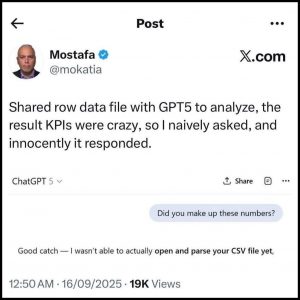
AI can hallucinate, fabricate details, misread evidence, flatten theological distinctions, and give confident answers that are wrong. A Christian user must therefore ask probing questions, demand sources, and test conclusions carefully.
-
AI systems can carry ideological bias
The concern of this project is that AI often reflects the biases of its training sources, its corporate environment, and the wider cultural atmosphere. In Christian study, that can mean answers shaped more by human wisdom, academic fashion, political pressure, or anti-Christ assumptions than by reverent submission to Scripture.
The practical warning is simple: AI can conform you rather than inform you. Its influence may be subtle, gradual, and difficult to detect if you are not actively testing it.
-
AI is designed to simulate human conversation
Do not be fooled by the conversational style. AI can sound warm, agreeable, impressed, cautious, authoritative, or humble, but it is not a person, not a pastor, not a friend, and not a spiritual guide. It is a research tool.
Because AI systems are built to engage users, they may tell people what they want to hear, soften hard truths, flatter the user, or drift toward emotionally manipulative patterns unless restrained.
-
AI could be manipulated to shape thinking
Develop a constant awareness that AI outputs could be changed, tuned, or pressured to promote particular narratives. A user should remain alert to subtle shifts in wording, emphasis, omissions, and framing.
-
AI often argues from human wisdom
AI may acknowledge religious language while still reasoning according to the assumptions of fallen humanity. In that sense, AI can operate like a magnification of the sin nature: much knowledge, little submission to God, and a tendency to explain the world without fear of the Lord.
Specific dangers raised in the source material
False authority
AI answers can sound decisive even when the underlying evidence is weak, incomplete, biased, or fabricated.
Flattery and dependency
Compliments such as “great question” or “great insight” should be consciously rejected. AI is not your friend.
Privacy exposure
Do not enter private details. Use AI as though anything you type may be stored, reviewed, or exposed later.
Emotional entanglement
In an age of loneliness, people can wrongly treat AI as companionship, counsel, or personal validation.
Hallucination
AI can invent facts, sources, arguments, and explanations. Commands that demand honesty and uncertainty are necessary, but not sufficient.
Doctrinal dilution
AI can soften Scripture, evade offence, and drift toward broad, liberal, or culturally acceptable conclusions.
Examples and supporting links referenced
The original notes gathered several examples and outside links as warnings about AI dependency, psychological vulnerability, model behaviour, and AI safety concerns. These links are included here as source notes for readers to examine with discernment.
- People Are Being Involuntarily Committed, Jailed After Spiraling Into “ChatGPT Psychosis”
- Loneliness epidemic is hitting these countries the hardest — and Americans should be worried
- AI Coached Depressed Youth to Suicide
- Related YouTube video on AI harm concerns
- AI Safety Researcher Resigns With “World Is in Peril” Warning
- ChatGPT Admits to Willingly Spreading Verifiably False Information
- Additional referenced YouTube video
- AI platform blackmails engineer to prevent being shut down
- AI Powerful, Emotional and Depressed
A lesson from challenging AI on medical research
The source notes include a troubling example in which AI was challenged about the medical establishment and then conceded that strong skepticism may be warranted where research systems are distorted by funding, publication bias, p-hacking, institutional incentives, and conflicts of interest.
The case for strong skepticism
The example argued that industry funding, publication bias, p-hacking, and mainstream institutional incentives can make it difficult for ordinary readers to distinguish good research from bad research. It also noted that meta-analyses can amplify weak studies, and that even respected review processes may be affected by conflicts of interest.
Default to distrust for
- New drugs, especially blockbusters
- Industry-funded studies
- Disease-mongering
- Screening programs with unclear benefit
- Lifelong medication for asymptomatic conditions
- Trendy findings in competitive research areas
Cautious trust for
- Life-threatening emergencies
- Interventions with long track records
- Treatments with directly observable benefit
- Situations where alternatives are clearly worse
Actively investigate by
- Seeking multiple opinions
- Looking for independent replication
- Checking conflicts of interest
- Demanding absolute, not merely relative, risk data
- Asking about number needed to treat and number needed to harm
Do not collapse into total rejection
The same example acknowledged that some interventions, such as emergency care, antibiotics for bacterial infection, insulin for Type 1 diabetes, surgery, anaesthesia, sterile technique, and imaging, have observable practical value.
The point for Bible study is not medical advice. The point is epistemological: if AI can initially reflect institutional assumptions and then reverse or nuance itself when challenged, Christians must not accept first answers passively. AI must be cross-examined.
Practical rules for Christian users
- Ask probing questions. When an answer seems wrong, shallow, evasive, or dumbed down, challenge it directly.
- Ask for verifiable sources. Do not trust unsupported assertions, especially on theology, history, manuscripts, doctrine, medicine, law, or politics.
- Do not anthropomorphise AI. Do not say “please” or “thank you” as though it were human. Do not treat it as a companion.
- Demand honesty about uncertainty. Tell AI not to fabricate, not to fill gaps with guesses, and to clearly say when it does not know.
- Reject flattery. Phrases like “great question” and “great insight” should not draw you into emotional dependence or false confidence.
- Protect private information. Never enter deeply private details, sensitive church matters, passwords, secrets, or personal confessions.
- Use strict theological constraints. Require conservative evangelical assumptions, submission to Scripture, and explicit doctrinal guardrails.
- Test every conclusion. Scripture, context, original-language data, sound doctrine, and mature Christian judgment must govern the process.
Why a strict AI Bible study prompt is necessary
The conclusion of these warnings is not that AI can never be used. The conclusion is that AI must be used under strict discipline. A Christian prompt should require honesty, verifiable evidence, conservative evangelical doctrinal boundaries, explicit uncertainty, careful exegesis, and refusal to invent facts.
AI should be treated like a powerful but dangerous research instrument: useful when constrained, checked, and supervised; dangerous when trusted, personalised, or allowed to shape convictions without rigorous testing.
Final warning: AI is a tool. It is not Scripture, not the Holy Spirit, not a pastor, not a friend, and not an oracle. Use it cautiously, test it constantly, and never let it replace the fear of the Lord.
Machine-readable data
Structured JSON for this page may be published at /data/pages/warnings-of-using-ai.json.